
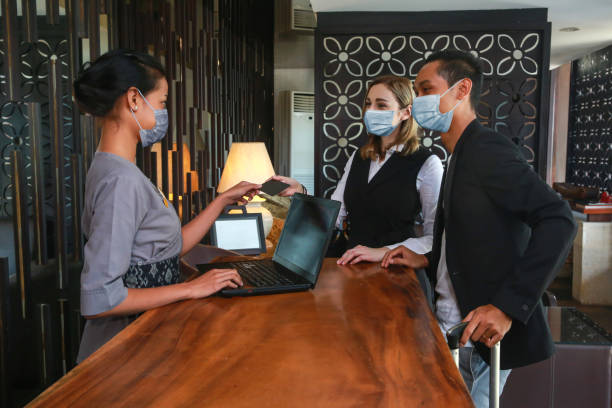
Consistency in guest services at a hotel
The standards for guest service are met to ensure that a hotel provides quality services. IH&RA and UNWTO have established general criteria and requirements for hotel services. A hotel must have clear technology for serving guests and give detailed instructions to staff to implement these standards. It is essential to not only create the documents but also to supervise the work of staff. Every method of providing services must be tried out and corrected if necessary.
Although the list of services might vary, the fundamental steps are generally followed in a specific order.
Four stages generally describe the process of providing services in a hotel.
- Time before you arrive at a hotel (booking a hotel room, prepayment).
- Check-in, registration and arrival at the hotel.
- Provide services to clients while they are staying in a hotel
- Check out, including the final payment.
Stay tuned for announcements on specific articles that will provide more information about booking, registration, check-in, and checkout.
If required, final preparations are made before the arrival of guests:
- Cleaning hotel rooms
- Booking extra services with external partners
- Meeting guests at the railway station or airport
A new stage of registration begins when a guest arrives at the hotel. This is the time a guest gets their first impression of a hotel. It should be fast, easy, and pleasant. Positive impressions are built on politeness, kindness, generosity, and prompt acceding.
The most important and longest stage of a stay at a hotel is when you are in the middle of the night. We will discuss it below.
Final payment, additional services and checkout are the last steps. Guests can be taken to the railway station or airport if necessary.
Staying in a hotel requires guest service.
The main service offered by hotels is hotel accommodation. If guests stay at the hotel for more than one night or, in certain cases, their hotel rooms must be cleaned after they have checked out. The daily apartment service includes the change of sheets and towels, additional bedding, and replenishment of consumer goods (particularly hygiene products). It is important to respect the rules for cleaning so that guests are not disturbed.
- You should get the approval of your guests before cleaning a hotel room.
- Room attendants must clean up quickly and not be distracted by personal items.
- Do not touch or read the notes of clients.
- Cleaning schedules for properties must be adjusted to accommodate the number of guests staying at the hotel.
- Do not leave cleaning and equipment out for the public to use. Instead, store them in a safe place.
It is much better to start cleaning the suites from:
- A bedroom
- A living-room
- a dining room
- A study
- A hall
- a bathroom.
Every room should be cleaned in clockwise or counterclockwise order to achieve the best results. It is important to check the working capabilities of light switches, sockets and telephones. If malfunctions are detected, they must be reported to the appropriate service. Sometimes guests can damage appliances. The hotel manager must address the issue with the guest.
Clients are provided with the main services (room and board) and receive additional services depending on their hotel category. Regular customers are offered discounts and additional programs to increase their loyalty.
A special article will be written about the details of a client loyalty programme later. Please wait for the announcement.
You can automate routine tasks to get better services at a lower cost and a higher quality. OtelMS hotel management software is cost-effective and can be used to train staff. It pays off in a few months.
Some customer categories: Features of serving
VIP Client Service at a Hotel
Although a hotel doesn’t change its standards for all clients, VIP client services require special attention. The Very Important Persons include people in business, politicians, and famous artists. Over time, VIP status can be granted to loyal clients who provide significant income for a hotel. These clients have a common need for high-quality, extra, more costly, and a high payment capacity.
Specially designed procedures are followed for VIP guests staying in higher quality hotels. While guests staying in a hotel, they must fulfil all their needs. All services and even the smallest things must be up to international standards. Even though it can be difficult to work with VIP clients, there are benefits for branding and financial. They can generate income and increase the hotel’s reputation. Each VIP client is treated individually, which increases guest loyalty. It is important that clients keep track of their personal preferences, likes, habits, and any extra services they order. Sometimes, it is necessary to make exceptions to these rules (e.g., obtaining a service without prepayment or expressing special wishes or needs not covered in the list of the standard services). Specially trained managers are available to communicate with VIP clients. Hotel staff must behave professionally and emphasize the guest’s status.
Not all hotels can accommodate VIP clients during the development process. They must be prepared to serve VIP clients as the first client could ruin a hotel’s reputation or become a loyal client.
Corporate clients have different payment methods than ordinary clients. They should be offered cashless payment options or pay in deferred payments.
These clients may be solvent, but they still enjoy the best discounts as they keep their money.
Corporate clients can’t use a standard cancellation policy. They need a special annulment. This means that they can cancel the booking without penalty, even on their arrival.
Enhance the quality of services
Automating a hotel is a direct business investment. This investment will pay off in improved services that attract new clients to hotels and positive opinions.
It is important to keep any hotel management system updated. The pace of time is changing, and clients might find it difficult to use services that were not offered before.